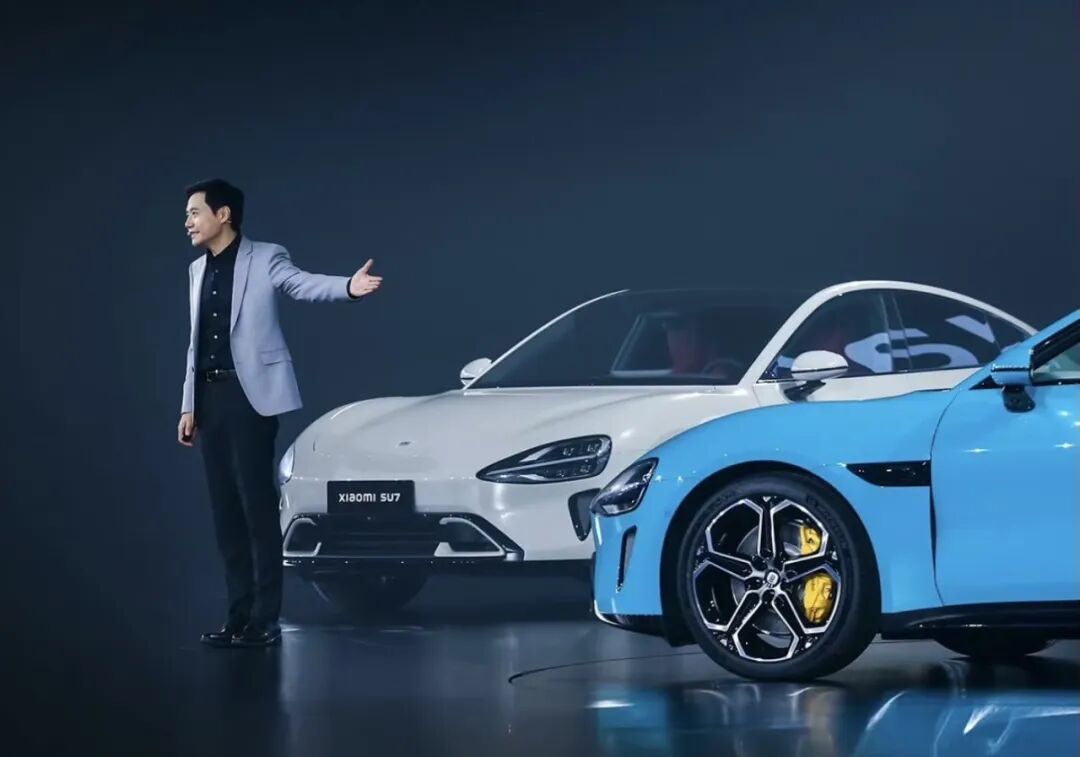
The most critical upgrades are smart driving and charging.
The entire lineup now comes standard with LiDAR; the electrical system has been upgraded from 400V to an 800V high-voltage architecture; assisted-driving computing power has been raised to 700 TOPS; a V6s Plus motor has been adopted; and safety equipment has been upgraded from seven airbags and 2000 MPa steel to nine airbags and 2200 MPa ultra-high-strength steel. The battery pack also adds a 1500 MPa anti-scrape crossbeam at the bottom.
Even for the door handles—previously mocked by some netizens—Xiaomi offered a solution: triple-redundancy door handles come standard across the lineup, ensuring mechanical unlocking even in extreme situations.
In terms of range, the new SU7’s Standard, Pro, and Max versions see their CLTC range increase to 702 km, 902 km, and 835 km, respectively. The previous SU7 delivered 700 km, 830 km, and 800 km, respectively.
In this generation, the model that best reveals Xiaomi’s redesign logic is the main sales driver: the Pro. For buyers shopping in the 200,000+ RMB pure-electric sedan segment, what truly matters isn’t whether the 0–100 km/h time is a few tenths quicker, but whether charging is fast and whether daily commuting and long trips are worry-free. So Xiaomi didn’t simply move the old Max’s features downmarket; instead, it upgraded the parts that most affect real-world feel: pushing CLTC range to over 900 km, bringing dual-chamber air suspension and CDC down to the Pro, and keeping the price under 250,000 RMB.
And the Standard version—which previously left people feeling it was “almost there”—has now added the 800V platform, LiDAR, safety upgrades, and braking upgrades all at once, taking on the volume-selling role.
The range-topping Max, meanwhile, leans into a more premium experience: a more complete package of cabin quietness and comfort, with some luxury features moving to higher specifications.
Even in small details, Xiaomi is trying to win users over with emotional value—for example, the 79 RMB NFC magnetic plush shown at the launch event. It’s not only merchandise meant to generate revenue; it’s also an attempt to enrich the cabin’s tech vibe and reinforce a youthful label.
So is this 4,000 RMB price increase actually worth it?
That depends on how it stacks up against competitors. At the launch event, Lei Jun compared the new SU7 with several rivals (the Model 3 Performance, Luxeed S7 Max, and a high-spec Zeekr 001). On paper, the SU7 Pro’s range, plus the dual-chamber air suspension + CDC that come standard on the Pro/Max, do create an “all-rounder” advantage at the same price point. Especially against the Model 3’s vision-only approach, the SU7 is trying to compete through differentiated hardware by piling on components.
But compared with the previous generation, the new SU7 is facing a group of rivals that have already pushed price, features, and smart tech competition down to the finest details. The Tesla Model 3 remains the unavoidable benchmark in this price band, with strengths in a mature ecosystem, efficiency control, and brand awareness; compared with Huawei-aligned brands, Xiaomi still needs to improve public perception of its driver-assistance capability; and models such as the Xpeng P7, Zeekr 007, and Zeekr 001 have long been fighting a positional war in the pure-electric sedan market, with a more mature understanding of high-voltage platforms, driver assistance, chassis tuning, and performance.
Overall, this generational refresh isn’t perfunctory. It doesn’t dodge the old Standard version’s slow charging, weaker intelligent-driving hardware, or the slightly awkward split between trims. Instead, it puts the most easily felt upgrades front and center, so users can see the differences at a glance.
Of course, sincerity and competitiveness are never the same thing. The latter question still has to be answered by the market.
One detail worth noting is that the order-locking rules for the new SU7 have changed this time.
In the past, Xiaomi’s production-scheduling logic carried a bit of a “whoever moves first gets the upper hand” flavor, ramping up emotions during the initial launch phase. This time, the focus has shifted to “confirming the configuration and completing order lock-in as soon as possible”: if you don’t lock in within three days, you can cancel for a refund, and you can change the configuration within the specified window without affecting the delivery lead time. The key variable determining production priority has changed from “when you paid the deposit” to “when you locked the order.”
This suggests that after the previous round of ultra-long delivery lead times, what Xiaomi cares more about now is locking orders down early and nailing the exact configurations—so production planning and delivery don’t end up on the back foot again.
To understand this shift, you first have to look at the roller-coaster Xiaomi went through over the past year.
Ten months ago, the YU7 pushed Xiaomi to its peak, at one point holding nearly 400,000 orders (including undelivered SU7 orders at the time). But delivery lead times that often stretched to six months—or even 10 months—also exposed the early-stage weaknesses in Xiaomi Auto’s manufacturing system.
As capacity at the Phase II plant ramped up, monthly deliveries began accelerating from September onward, climbing to 40,000 and even breaking through 50,000. The YU7 contributed about 70% of deliveries in October and November, and by December it had become the undisputed mainstay.
Total deliveries in 2025 exceeded 410,000. Compared with 136,000 in 2024, that was nearly triple. On the surface, Xiaomi had made it through the toughest part of the startup phase and joined the ranks of automakers operating at scale.
But heading into 2026, as the older SU7 was discontinued and YU7 orders were worked down, deliveries began to fall back.In January, they were above 39,000; in February, above 20,000.
Some industry insiders analyzed that by last December, Xiaomi’s actual monthly capacity had already reached 50,000 units. Even if it burned through orders at a pace of 30,000 a month, the backlog it accumulated in the second half of 2025 would be fully digested by mid-2026. At that point, the supply-demand dynamic would shift from “people queueing for cars” to “cars waiting for customers.”
That is also why the next-generation SU7 had to step in at this critical juncture.
In 2026, Lei Jun set Xiaomi Auto a target of delivering 550,000 vehicles for the full year—meaning it had to accelerate by another 34% on top of an already high base. Deliveries in January–February totaled 59,000 units; that leaves roughly 491,000 units to be completed over the remaining 10 months, requiring an average of 49,100 deliveries per month. Compared with the 2025 monthly average of about 34,200 units, the challenge speaks for itself.
Where will this extra hundred-thousand-plus units of incremental volume come from? The investor mentioned above ran the numbers for us.
YU7 is still the foundation. It delivered 39,000 units in December 2025 and 38,000 units in January 2026. Going forward, it also needed to maintain a monthly delivery pace of 30,000–35,000 units, carrying the bulk of sales at 360,000–420,000 units. That meant it could not afford any major quality issues or PR crises, nor could it fall behind amid competitors’ encirclement.
The incremental growth depended mainly on the new SU7. The first-generation SU7’s cumulative deliveries topping 381,000 units was already in the past; starting in the third quarter, the new SU7 had to deliver a steady 15,000–20,000 units per month, contributing 100,000–150,000 units for the year.
Finally, there were some potential sources of incremental volume. New models planned for the second half of 2026 (the SU7 Executive Edition, the YU7 GT, and an extended-range SUV), if launched on schedule and able to make a splash in their respective segments, could add roughly 30,000–50,000 units.
Once you do the math, it becomes clear that the market the new SU7 faced was no longer the “beginner’s village” of two years ago—when consumers were full of curiosity about Xiaomi. Against the backdrop of the phase-down of purchase-tax incentives for new-energy vehicles, and in the most brutally competitive RMB 200,000–300,000 pure-electric sedan segment, it had to refill Xiaomi’s order book—and the difficulty doubled.
Sales volume was only the visible pressure; below the surface, Xiaomi still faced several hurdles.
From the launch of its first car in April 2024 through mid-2025, riding on Lei Jun’s top-tier traffic and the “Human x Car x Home full-ecosystem” narrative, Xiaomi Auto successfully flipped the table and grabbed a big slice of the pie.
Lei Jun unveils the first-generation SU7
But when growth is too fast, many problems are easily obscured. For example, due to adjustments in production scheduling strategy, accident-related controversies, and public-opinion turmoil, the Xiaomi YU7 previously lost some orders. As competition moved into a stalemate and Xiaomi entered a product transition period, some of the issues below the surface began to come to light.
First comes the test of product quality and trust.
Over the past year, Xiaomi Auto was caught up in a number of accident-related controversies that drew widespread attention. Regardless of the underlying cause, they planted a lingering question in the public mind: “Is Xiaomi Auto safe enough?”
In response, Xiaomi did two things. First, Lei Jun personally hosted a four-hour car tear-down livestream, facing jokes such as “the median-strip war god” head-on; at this launch event, the company also demonstrated a high-temperature, fully charged battery nail-penetration test…… Second, it rolled out targeted product upgrades, including mechanical door handles on the new SU7 and an anti-scrape crossbar under the battery pack.
Second is the competitiveness of its intelligent driving.
2026 is a pivotal year for the rollout and divergence of advanced intelligent driving. Rivals such as Huawei and Xpeng are continuously raising the bar for the entire industry. In the past, although Xiaomi also equipped its cars with high-compute chips, public perception still placed its smart-driving capability in a “making up for basic shortcomings” phase. A large-scale recall in September last year, triggered by a logic flaw in the driver-assistance software, exposed its weaknesses in handling complex scenarios.
In the 200,000–300,000 yuan core battleground, intelligent driving has already become a decisive factor in whether consumers open their wallets. That’s why the new SU7 not only maxes out hardware across the entire lineup, but also introduced an enhanced version of Xiaomi HAD powered by the XLA cognitive large model. It even integrates embodied-robotics technology to enable parking-space-level navigation in mall underground garages. Still, what this new system feels like in real use remains to be tested in real-world driving conditions.
Finally—and the toughest issue: brand public-opinion management.
Xiaomi’s “internet-celebrity” nature and its deep linkage to Lei Jun’s personal IP were once powerful tools for igniting the market at relatively low cost. In the past, when he stepped forward, he could bring Xiaomi attention, and part of the audience was willing to trust Lei Jun first and the product second. But in the far more complex public-opinion arena of carmaking, the side effects of that model have surfaced.
On the one hand, negative sentiment around Xiaomi can escalate easily. Excessive visibility means that product flaws, after-sales disputes, or even a single accident can be magnified into a full-blown public-opinion incident, eroding trust in the brand. Lei Jun himself admitted that over the past year, “the wave of public opinion hitting us head-on left all of us a bit stunned,” and that the attacks even left him with a psychological shadow.
On the other hand, when a public-opinion flare-up occurs, the blame is prone to point straight at Lei Jun personally, forcing him to step in to “put out the fire.” “This kind of ‘self-proving’ communication can evoke emotional resonance, but it also means the company’s public-opinion issues are always accompanied by controversy, even debate,” said an industry insider who follows Xiaomi.
More challenging still is that Xiaomi has to strike a balance between managing the emotions of its massive “Mi Fan” base and making rational brand decisions. A recent example is the intense backlash after the marketing team engaged a controversial KOL, followed by Xiaomi’s swift, heavy punishment of those responsible. This “turning the blade inward” helped Xiaomi win back some goodwill in the court of public opinion and, to some extent, offset some of the negativity around its products. But sooner or later, Xiaomi must move from “building the brand through a person” to “establishing the brand through products and technology.”
These three issues—quality, intelligent driving, and public opinion—are not problems that the new SU7 alone can fully solve, and they are interconnected: quality or intelligent-driving issues can ignite an uproar, and the public-opinion environment can in turn magnify the first two kinds of problems many times over.
That’s why the real contest begins after Lei Jun steps off the stage: Xiaomi Auto’s deliveries, reputation, and its response mechanisms when problems arise will determine whether, after experiencing a market-cap pullback, mounting business pressure, and repeated swings in public sentiment, it can move from a strong start to steady progress.
 快報
快報


根據(jù)《網(wǎng)絡(luò)安全法》實名制要求,請綁定手機號后發(fā)表評論